
RM3542C-2: Resistance Meter for Production Testing, 16 Ranges, GP-IB


Product information RM3542C-2: Resistance Meter for Production Testing, 16 Ranges, GP-IB
Key Specifications
- Measurement time from 0.9 ms
- Accuracy up to ±0.006 % rdg. ±0.001 % f.s.
- Contact improvement before and contact check during measurement
- Jumper mode and 5 V applied voltage limit (RM3542C-1 to -3)
- BIN function with 7 bins and ΔR function (RM3542C-3)
Typical Applications
- 100 % testing of passive components on taping machines and sorters
- Fast pass/fail testing of zero-ohm resistors (jumpers)
- Grading of chip resistors by tolerance on sorting systems
- In-process and sampling inspection of ferrite beads, inductors and common mode filters
- Resistance comparison before and after voltage stress testing of chip resistors
| Feature | RM3542C-1 | RM3542C-2 | RM3542C-3 | RM3542C-4 | RM3542C-5 |
|---|---|---|---|---|---|
| GP-IB | – | yes | – | – | yes |
| Measurement ranges | 16 | 16 | 17 | 10 | 10 |
| Lowest range | 100 mΩ | 100 mΩ | 10 mΩ | 100 mΩ | 100 mΩ |
| Low-power ranges | 6 | 6 | 6 | 4 | 4 |
| Jumper mode | yes | yes | yes | – | – |
| 5 V applied voltage limit | yes | yes | yes | – | – |
| Preset, stage mismatch prevention | yes | yes | yes | – | – |
| BIN function (7 bins) | – | – | yes | – | – |
| AR function | – | – | yes | – | – |
| Averaging | – | – | yes | – | – |
| 90-day accuracy | – | – | yes | – | – |
| Comparator resolution | 10 ppm | 10 ppm | 1 ppm | 10 ppm | 10 ppm |
Detailed Product Overview
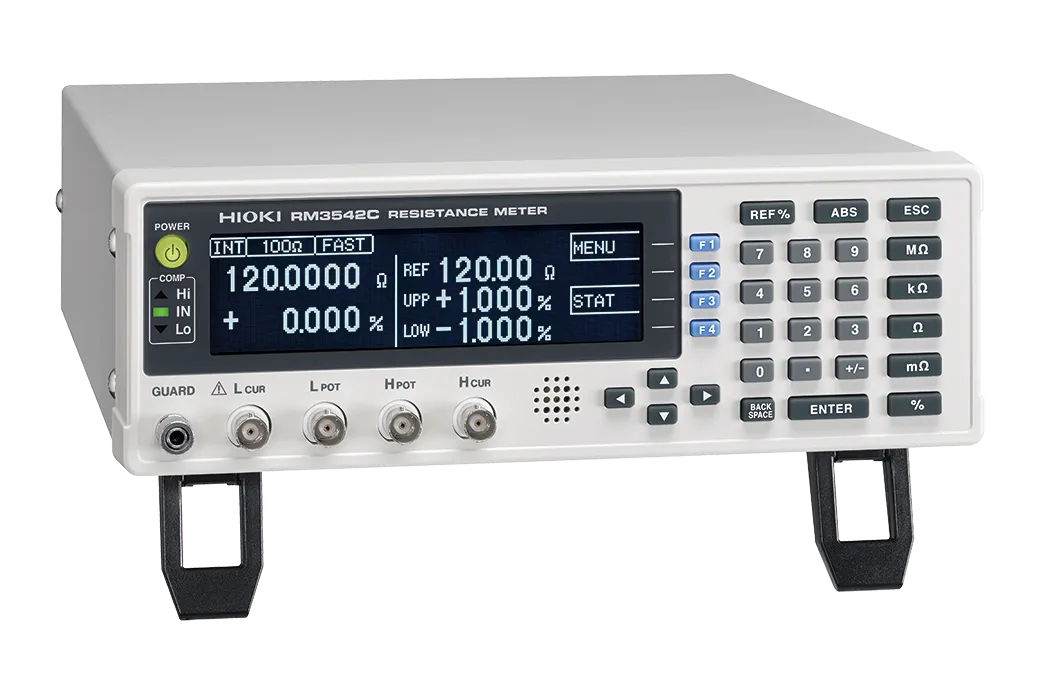
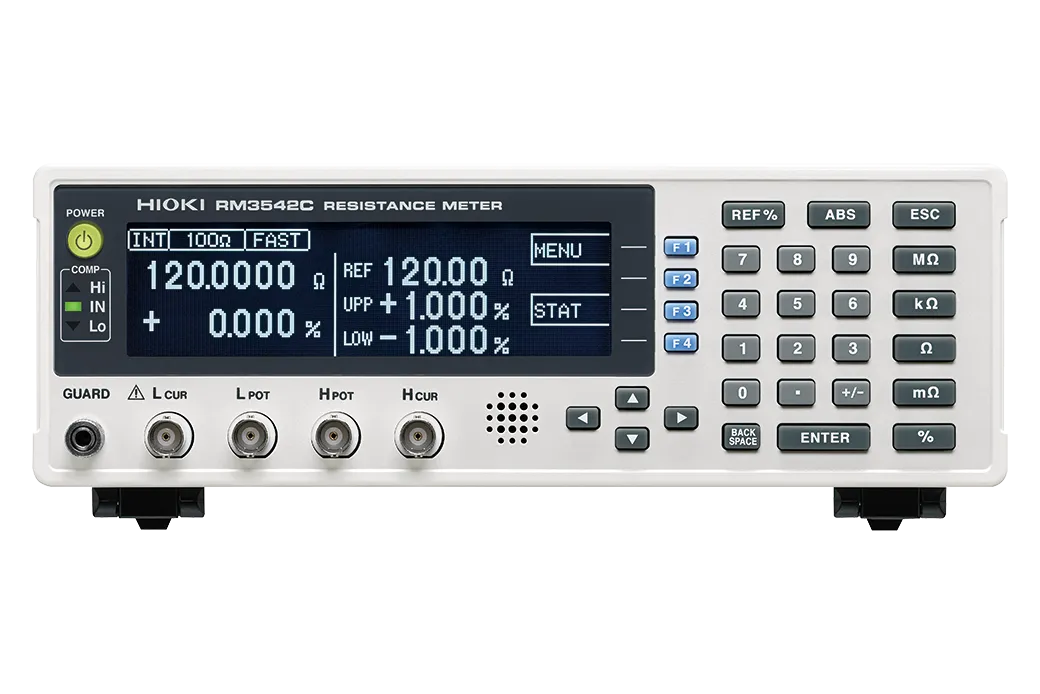
The HIOKI RM3542C is a DC resistance meter for automated test systems that require high throughput and reliable test results. Typical applications are taping machines and sorters, for example for chip resistors and ferrite beads. The instrument measures using the fourterminal method and makes the pass/fail decision itself. In the 100 Ω and 1000 Ω ranges, a measurement takes 0.9 ms at the fastest speed setting, and the result goes straight to the machine via EXT I/O. To make sure a fast decision is also a correct one, the RM3542C improves probe contact before each measurement and monitors it throughout.
Depending on the version, it measures in 10, 16 or 17 ranges between 10 mΩ and 100 MΩ. Its best one-year accuracy of ±0.006 % rdg. ±0.001 % f.s. is achieved in the 1000 Ω range at the SLOW speed setting. The comparator works with a resolution of 10 ppm, or 1 ppm on the RM3542C-3, which makes it well suited to high-speed testing of class B resistors.
Takt time and repeatability
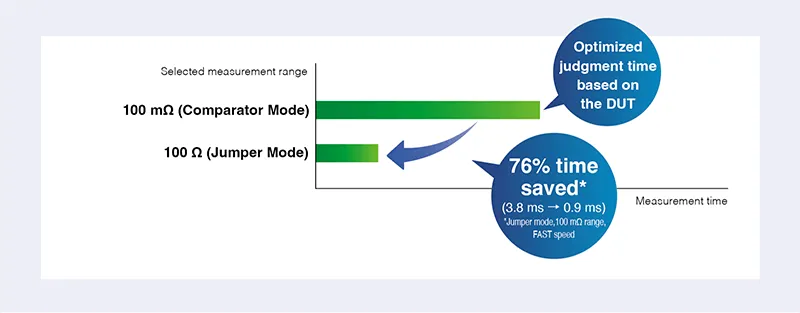
With zero-ohm resistors, also known as jumpers, a fast and reliable pass/fail decision matters more than the highest accuracy. With an upper comparator limit of 100 mΩ, the RM3542C measures in the 100 mΩ range and takes two readings there with reversed current polarity to cancel thermal EMF, which takes 3.8 ms at the fastest speed setting. On the RM3542C-1 to -3, jumper mode sets a lowest range of 1000 mΩ, 10 Ω or 100 Ω instead. In the 100 Ω range, the instrument measures without offset compensation and needs only 0.9 ms, 76 % less time, with accuracy that is sufficient for jumpers.
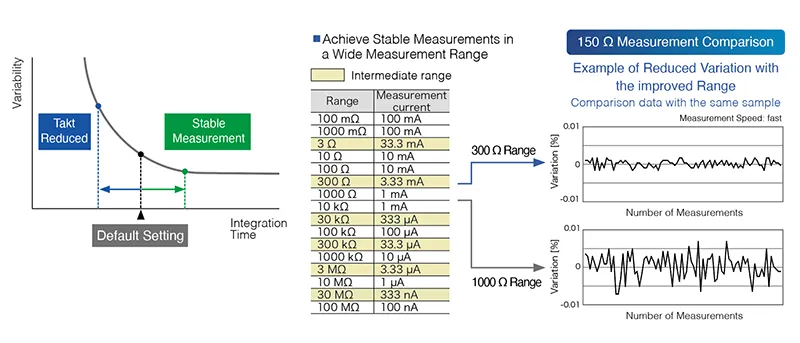
The integration time can be set separately for each range and for each of the three speed settings FAST, MED and SLOW. Short integration times maximize throughput, while longer ones give stable, repeatable readings in final inspection. The RM3542C-1 to -3 also offer intermediate ranges of 3 Ω, 300 Ω, 30 kΩ, 300 kΩ, 3 MΩ and 30 MΩ. A 150 Ω resistor, for example, is then measured in the 300 Ω range at 3.33 mA rather than in the 1000 Ω range at 1 mA. This improves the signal-to-noise ratio and reduces the spread of readings, even at the fast speed setting.
Preventing and detecting contact errors
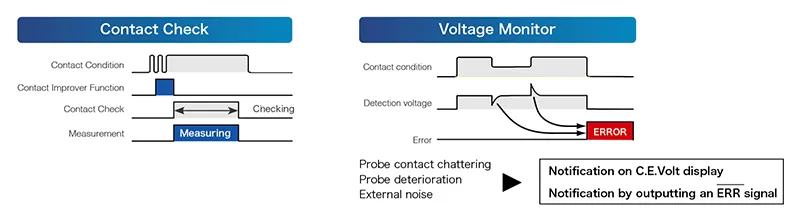
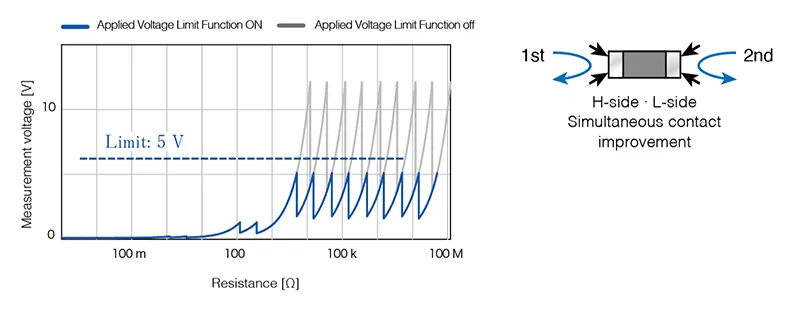
Oxide films and contamination between probe tip and electrode cause contact errors and remeasurements. Before each measurement, the contact improvement function therefore drives a current from the POT to the CUR probes that breaks through these layers. In pulse mode, the current flows only immediately before the measurement, which reduces heating of the device under test.
During measurement, the RM3542C monitors contact continuously. The contact check verifies the connections between HPOT and HCUR and between LPOT and LCUR, so it also detects bouncing probes. The voltage level monitor flags an error when fluctuating contact resistance at the current probes causes a significant change in the detected voltage. Between measurements, the probe short-circuit detection finds conductive debris between the POT and CUR tips that would prevent a true four-terminal measurement. If a probe bounces, the retry function repeats the measurement automatically.
Gentle testing of sensitive components
Very small chip resistors such as size 0201 (metric, imperial 008004) have a low rated voltage. The RM3542C-1 to -3 therefore offer an applied voltage limit that restricts the voltage across the device under test to 5 V by automatically selecting a suitable range. An 8 kΩ resistor, for example, is then measured at 333 µA instead of 1 mA, so only 2.6 V is applied to it.
For ferrite beads, multilayer inductors and other current-sensitive components, low-power resistance measurement uses a reduced measurement current, in six ranges from 1000 mΩ to 1000 Ω on the RM3542C-1 to -3 and in four on the RM3542C-4 and -5. In the 100 Ω range, for instance, the current drops from 10 mA to 1 mA and the power in the device under test from 10 mW to 100 µW.
Integration into automated test systems
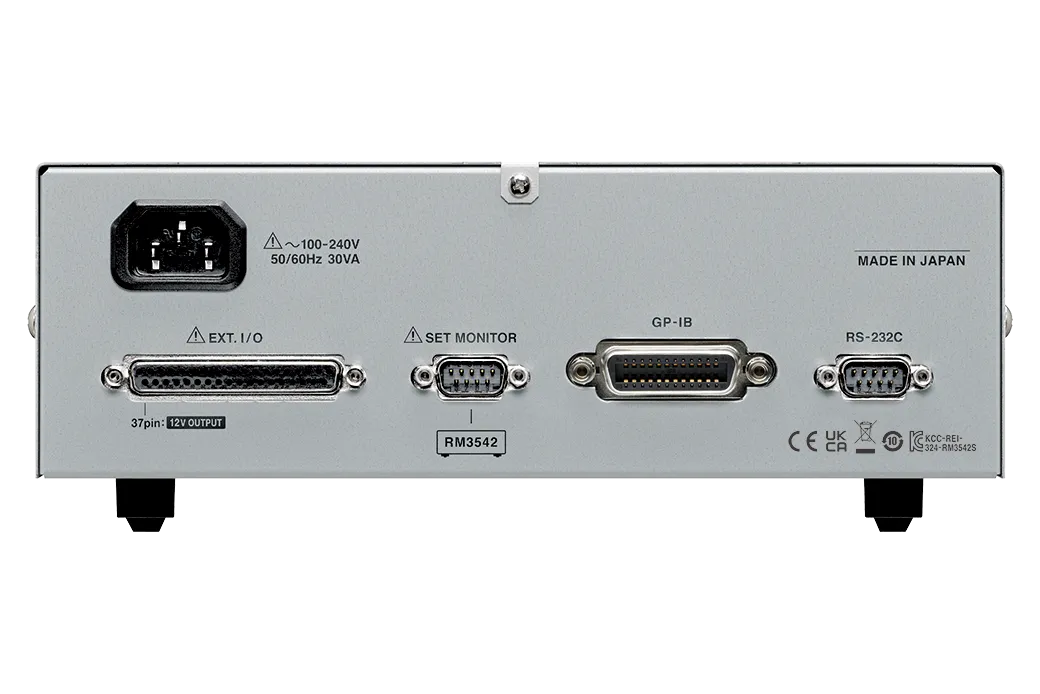
The measurement section of the RM3542C is galvanically isolated from the control section, and the specified accuracy is maintained even with ±1.5 kV mixed pulse noise. Even switching large induction motors has little effect on the readings, and the instrument complies with EN 61326 Class A for industrial environments. Via the photocoupler-isolated EXT I/O interface (37-pin D-sub), a PLC starts measurements and receives the comparator result, end-of-measurement and error signals.
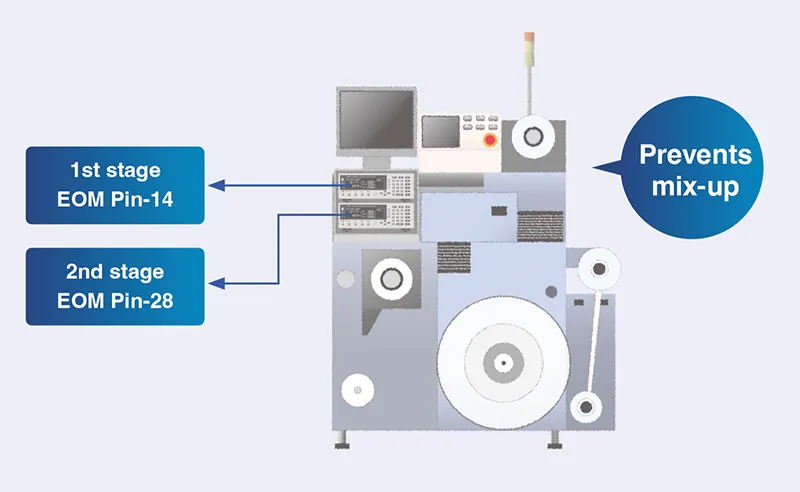
Where two instruments work in successive stages on one machine, the 9637 RS-232C Cable connects their SET MONITOR ports. The instruments then compare their comparator settings and measurement speed and block the measurement start if these differ. With stage mismatch prevention on the RM3542C-1 to -3, each instrument outputs its end-ofmeasurement signal on a separate pin depending on the configured stage, so instruments swapped during maintenance or calibration are noticed immediately. These models also have a preset function that stores a complete measurement setup for product changeovers. Test leads and fixtures are not included and are chosen to suit the application. HIOKI offers the 9140-10 4-Terminal Probe and the 9262, 9263 and IM9100 test fixtures, which mount directly on the instrument.
Grading and process comparison with the
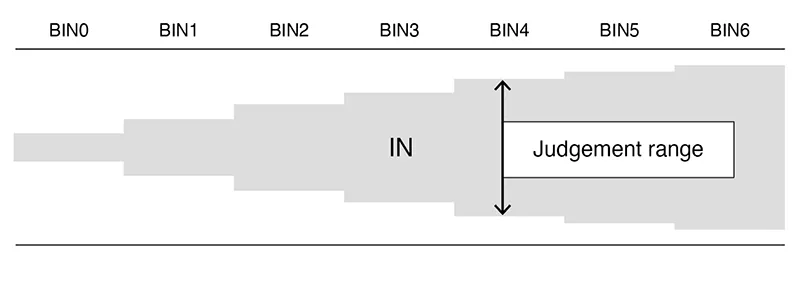
RM3542C-3 The BIN function of the RM3542C-3 compares each reading with the limits of up to seven bins, BIN0 to BIN6. The limits are set as percentages of a reference value, and readings outside all bins are judged as OB (out of bin). The result goes straight to the machine via EXT I/O, so the host system no longer has to do the grading. This reduces the load on the controller and shortens response times on lines with tight takt times. The bin limits are configured with communication commands.
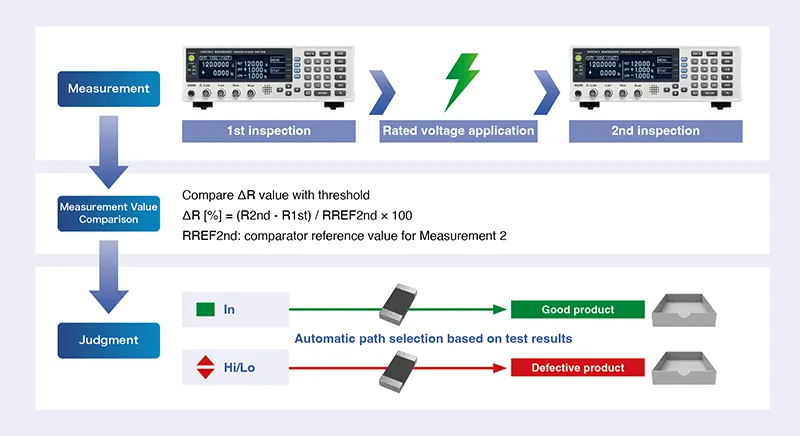
For high-reliability chip resistors, the resistance may change only by a specified percentage after rated voltage stress. With the ΔR function, two RM3542C-3 units handle this comparison themselves. The first-stage instrument sends its readings via the SET MONITOR port to the second-stage instrument. This calculates the change relative to its reference value and judges it together with its own comparator result.
Five versions with 10, 16 or 17 measurement ranges
The RM3542C-1 and RM3542C-2 measure in 16 ranges from 100 mΩ to 100 MΩ, while the RM3542C-3 adds a 10 mΩ range with 10 nΩ resolution for a total of 17 ranges. The RM3542C-3 also offers averaging over 2 to 32 measurements and an additional 90-day accuracy specification, for example ±0.005 % rdg. ±0.001 % f.s. in the 1000 Ω range.
The RM3542C-4 and RM3542C-5 measure in 10 ranges from 100 mΩ to 100 MΩ without intermediate ranges and in four low-power ranges. They do not offer the applied voltage limit, jumper mode, presets or stage mismatch prevention. Measurement times in the shared ranges, contact improvement, contact monitoring and noise immunity are the same as on the other models. All versions have RS-232C, EXT I/O and a SET MONITOR port, and the RM3542C-2 and RM3542C-5 add a GP-IB interface.
- RM3542C Resistance Meter
- Power Cord
- EXT I/O Connector (male)
- Startup Guide
- Operating Precautions
Dimensions & Packaging
| Length | 260 mm |
|---|---|
| Width | 300 mm |
| Height | 88 mm |
| Weight | 3.9 kg |
Related Products


How to Purchase Your HIOKI Products
Whether you order directly from HIOKI EUROPE or through an authorized distribution partner: choose the route that fits your procurement process. Our authorized HIOKI partners can assist locally with quotations and orders in your language.
