Log in or Sign up
Exclusively for business customers in the EU, Norway, UK and Switzerland
Fast shipment from Germany
Go to homepage
Maintenance
  • Battery testers handheld
  • Resistance meters handheld
  • Loggers & recorders
  • Power loggers
  • Power quality analyzers
  • Insulation testers
  • Clamp meters
  • Multimeters
  • Phase sequence testers
  • Earth resistance testers
  • Lux meters
R&D / Production
  • Current sensing
    • Precision current clamps
    • Wideband current probes
    • Current transducers
    • General current sensors
  • Battery testers
  • Power measurement
  • LCR meters / Impedance analyzers
  • Loggers & recorders
  • Resistance meters / Voltmeters
  • Electrochemical Testing
  • Voltage & signal acquisition
Accessories
  • Test leads & probe tips
  • Test fixtures
  • Connection cables
  • Power supplies
  • Software / Firmware
  • Rack-mount-kits
  • Data storage
  • Cases, bags & protectors
  • More
SALE (- 20%)
Blog
Spare parts
Log in
or sign up
Overview Your profile Addresses Payment methods Orders
€0.00*
Need help?
Need help?
Do you have questions or require assistance?

Get in touch:

hioki@hioki.eu

Contact form

Show all categories A Bass Mod, Two Multimeters, and a Lesson Learned
Back Show A Bass Mod, Two Multimeters, and a Lesson Learned
  • Maintenance
  • R&D / Production
  • Accessories
  • SALE (- 20%)
  • Blog
  • Spare parts
  1. You are here:
  2. Home
  3. Footer
  4. Customer Service
  5. Blog
  6. A Bass Mod, Two Multimeters, and a Lesson Learned

A Bass Mod, Two Multimeters, and a Lesson Learned

Kai Scharrmann · 05.02.2026
Current Measurement | Power Electronics · 7 min. reading duration

“Work on your timing,” my bass teacher would probably say. While modding a bass guitar, I ended up comparing two multimeters and stumbled across a reminder that measurements alone don’t tell the whole story. A short read about bass mods, practical measurements, and why understanding a circuit still matters.
A Bass Mod, Two Multimeters, and a Lesson Learned
Kai Scharrmann
VP Sales, PM & Marketing, HIOKI Europe
Share post!

In fact, that bass I worked on is even called “Bastelbass” (“modding bass”). I also own another bass from Humanbase that I would never touch, as in my view it’s a work of art. The Humanbase is not only a wonderful instrument to play, it is also my safety net when one of my modding ideas goes wrong, like my attempt to improve the neck connection to the body by using machine screws. That particular idea was a close call. If you ever thought about doing something similar, don’t, because maple is very hard and difficult to work with.

My latest research project was the possibility to select different tone caps. Basically, the higher the value of the capacitor, the more vintage the sound. Typical for bass guitars is 47 nF. For normal electric guitars it’s 22 nF, and for the real vintage bass guitar sound some people use 68 nF caps. Combining a 22 nF and a 47 nF cap through an “on-on-on” switch, there is a possibility to select between the values 22 nF, 47 nF and 69 nF. The latter is achieved when both caps work in parallel, which is the middle position of an “on-on-on” switch.
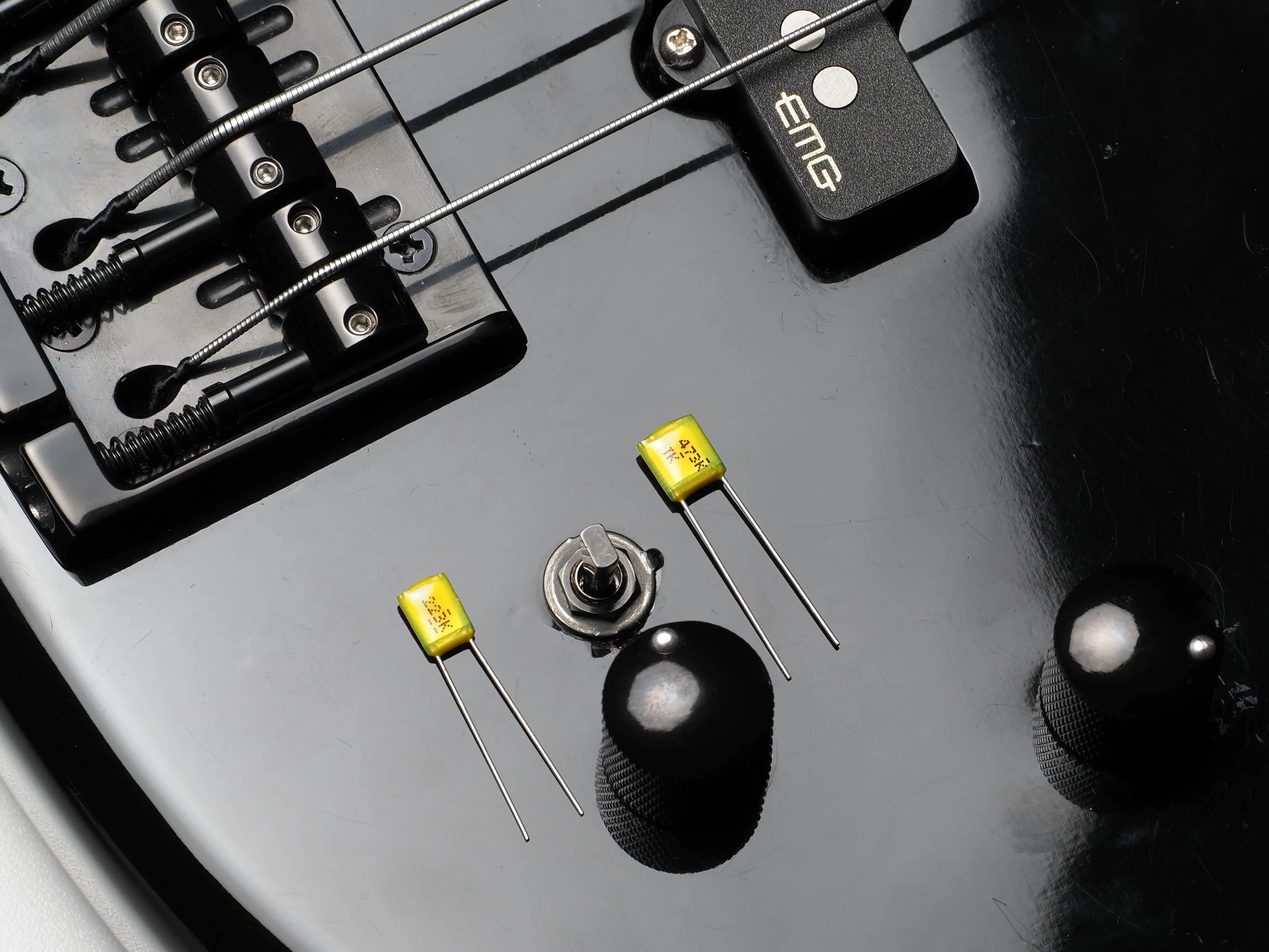
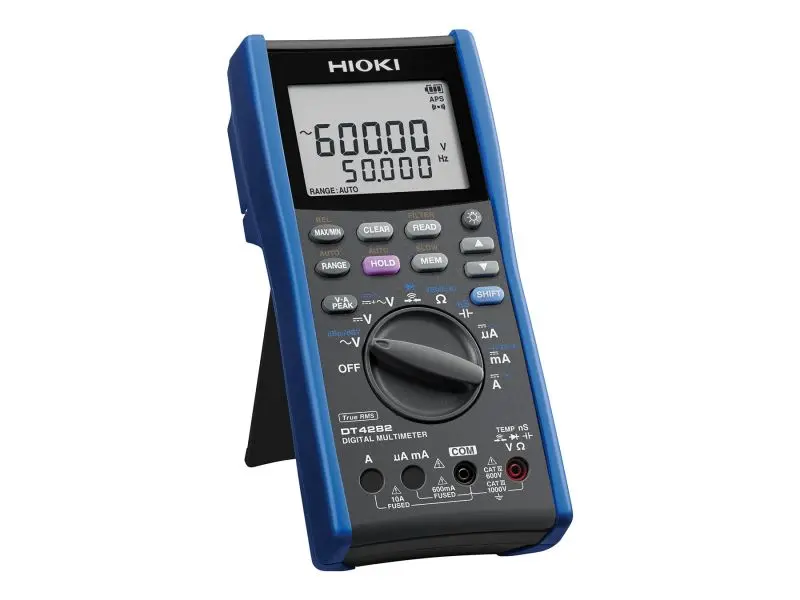
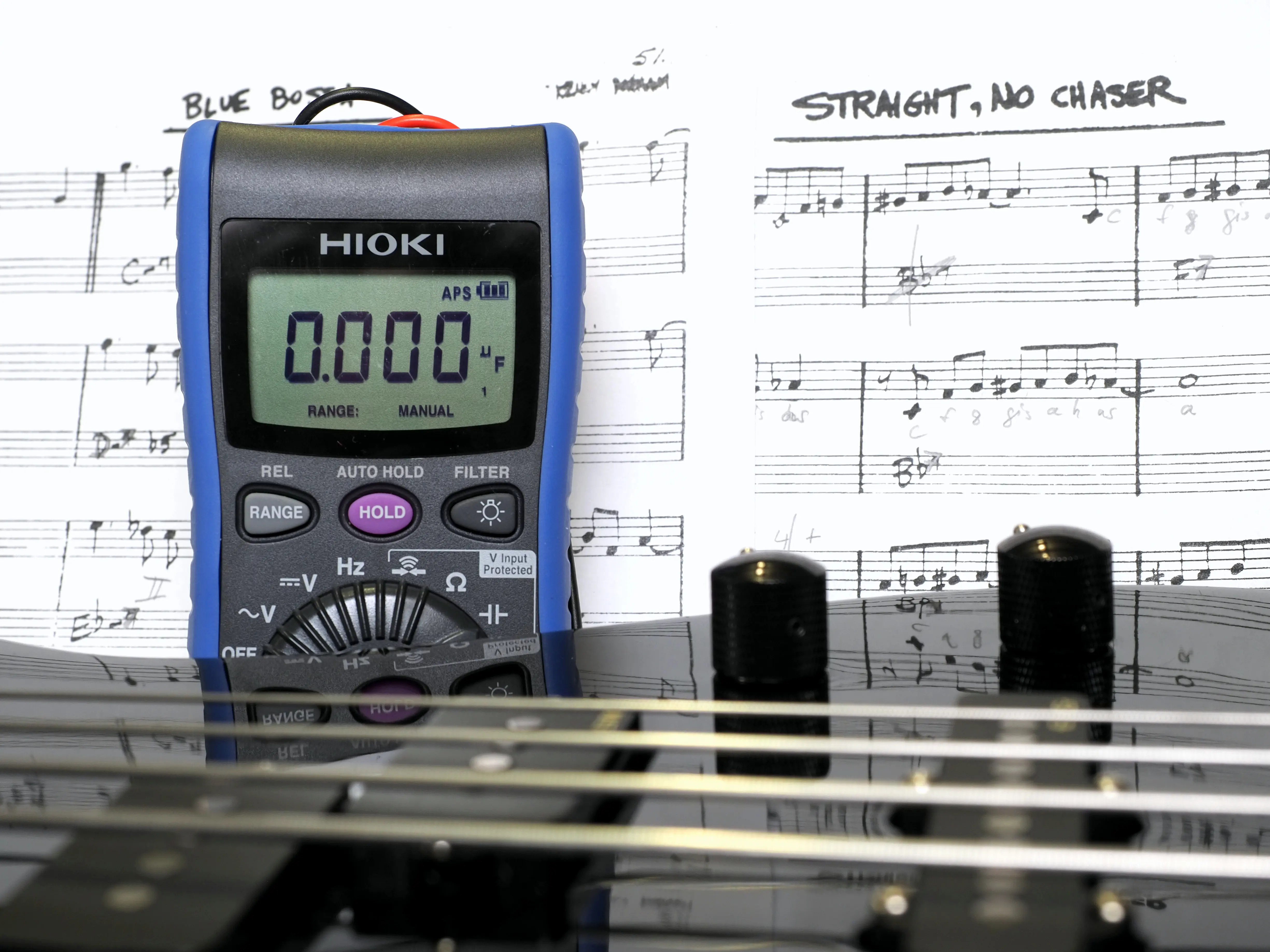
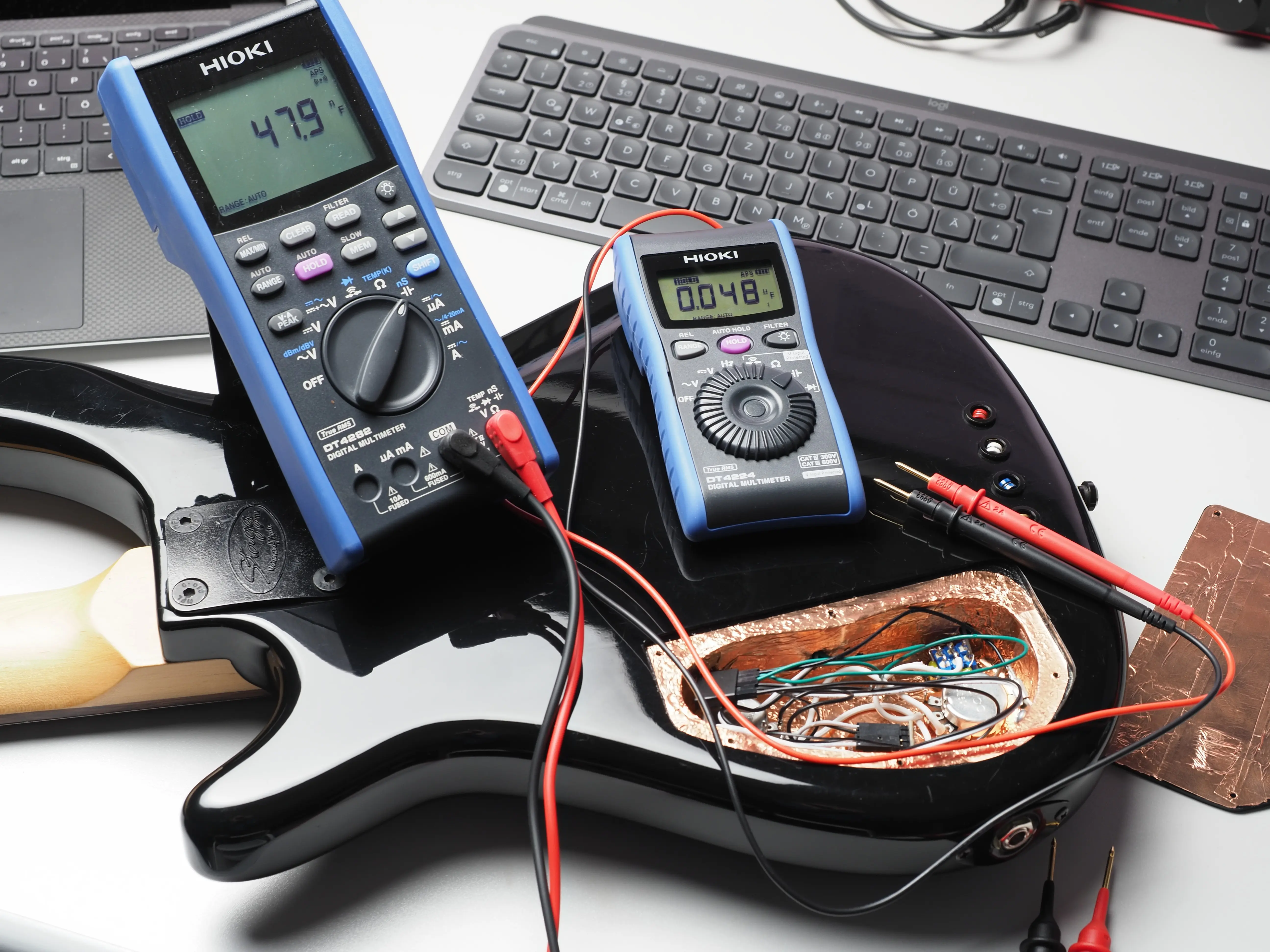
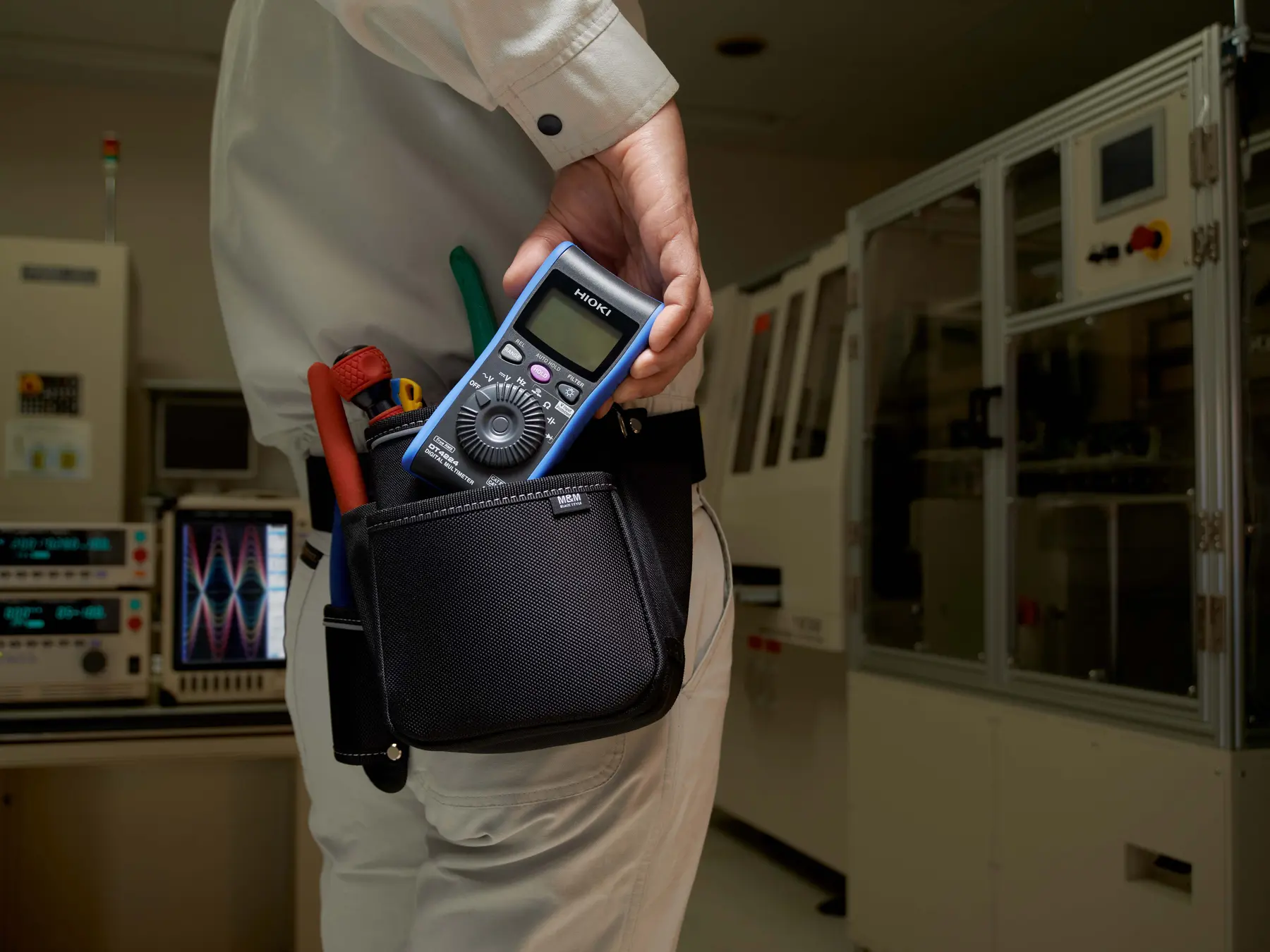
Obviously, I wanted to test whether I have properly soldered the caps into my “on-on-on” circuit. Yes, I could have done this with an LCR meter like HIOKI’s IM3533 or even an impedance analyzer like the IM3570. But a good general-purpose multimeter will deliver the same result as well. In line with the famous dart scene from “Ted Lasso” (“Be curious, not judgmental”), I decided to test the caps with HIOKI’s highest-spec handheld multimeter, the DT4282, and one from the “pocket range” of DMMs, the DT4224.

I wanted to make that comparison because the DT4224 has a voltage input protection. When making a resistance or capacitance measurement, the input needs to be low impedance. However, if by accident the DMM is set to resistance or capacitance measurement and someone tries to measure mains voltage, the RCD of that circuit would certainly trip. That’s not a really big deal in my basement, but imagine if this happens during maintenance work in a production environment.
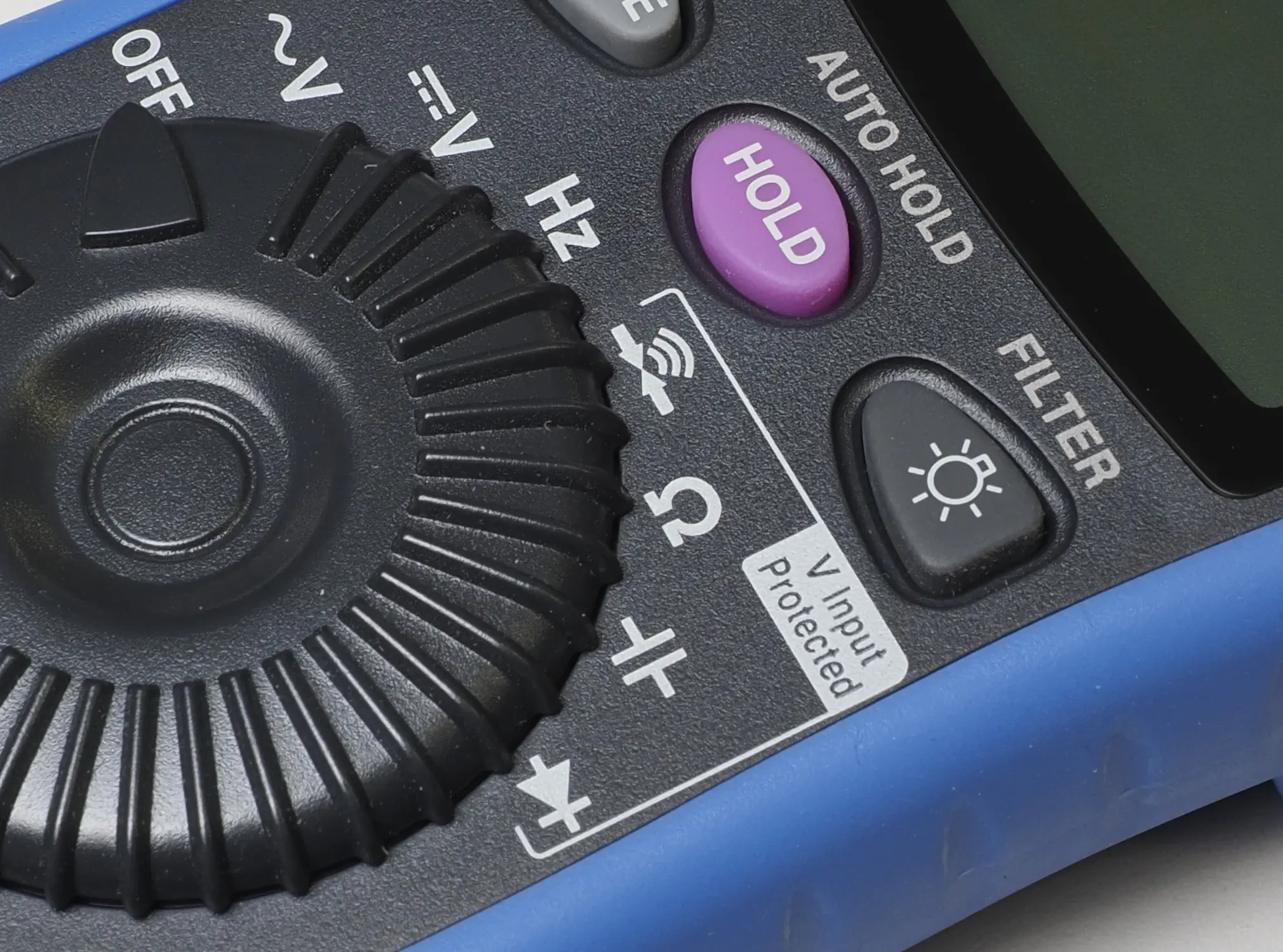
To avoid this scenario, the DT4224 (like its sibling DT4223) will first check for a voltage with the input in high impedance. Only if there is no voltage at the input will the DMM switch into low-impedance mode for the resistance or capacitance measurement. That check obviously takes time, and I was curious to see whether it’s noticeable.

It is (noticeable). The DT4282 is faster at making that capacitance measurement. I wasn’t curious enough to build a setup to find out how much faster. But let me put it this way. The practical difference was about as much as the difference in measurement results. The 47 nF cap was measured as 48 nF by the small DT4224 and as 47.9 nF by the top-range DT4282. Which means there is no practical difference in everyday use.
What I did not expect, however, was that this small measurement exercise would turn into a reminder of why understanding a circuit matters just as much as measuring individual components. At one point during the modding process, the tone control of my bass suddenly started behaving like a volume control. All component values were correct, the solder joints looked fine, and the multimeter readings were perfectly reasonable. And yet, the circuit behavior was clearly wrong.

The root cause turned out to be neither the capacitors nor the potentiometer itself, but a missing reference: a proper ground connection at the volume pot. Resistance or capacitance measurements with a multimeter use DC test signals, while a bass guitar operates with AC audio signals. Without a solid ground reference, the measurements still looked “correct”, but the circuit itself was effectively floating. Once the ground connection was properly restored, everything behaved exactly as expected again. That was a good reminder that measuring individual components is only half the story. Knowing where and what you are measuring is just as important.

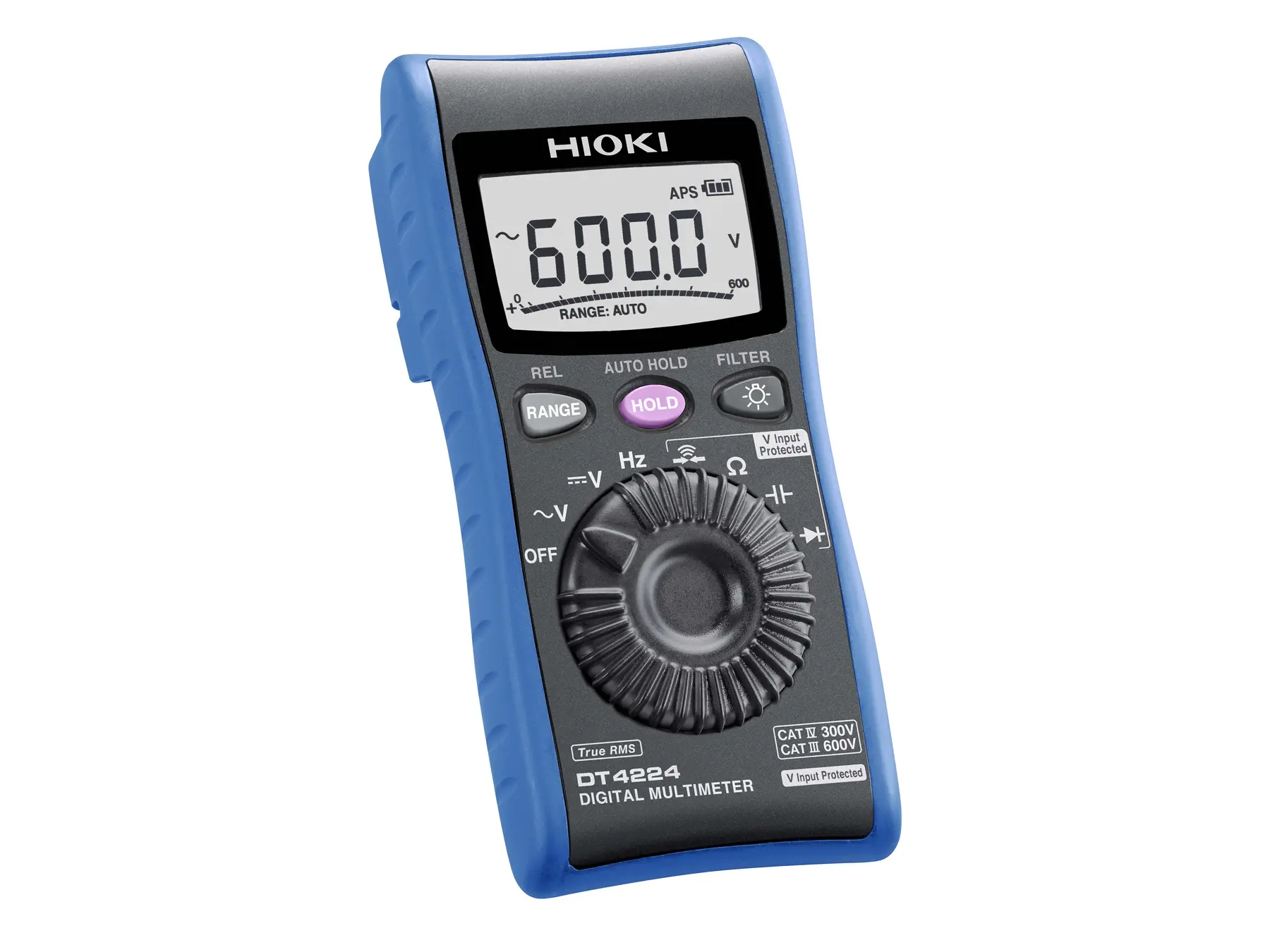
So what’s the takeaway from this post? If you’re looking for a small, high-quality digital multimeter, the DT4224 is a very sensible choice. Especially if you can’t remember the last time you measured current with a handheld DMM. It was not only developed in Japan, but is also manufactured there. And yes, I really should work on my timing instead of writing texts like this.
HIOKI DT4224 digital multimeter cat  iv 300v cat iii 600v includes dt4911 testlead HIOKI DT4224 digital multimeter cat iii 600v cat iv 300v portable
DT4224
DT4224 - Universal Pocket Digital Multimeter
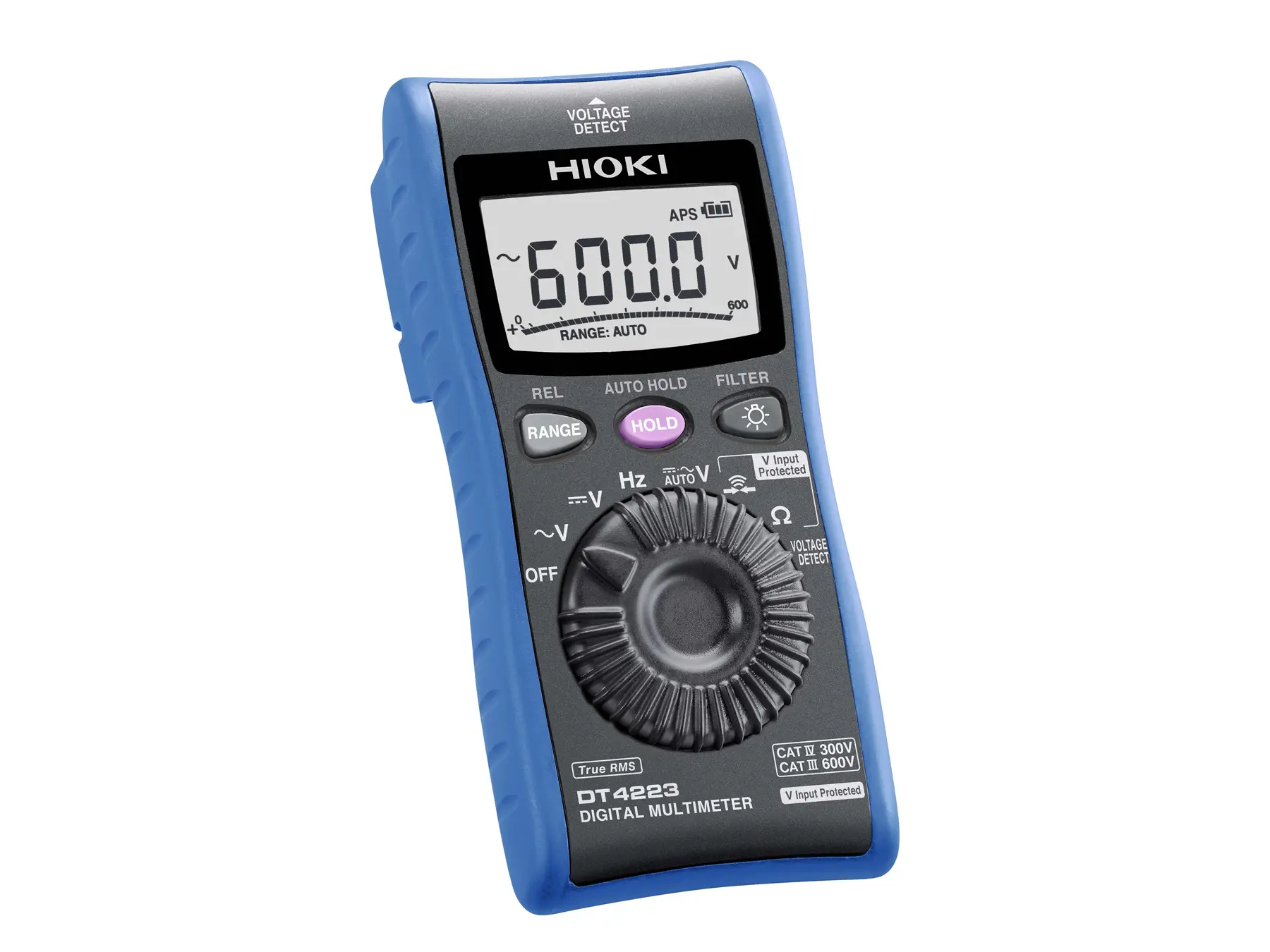
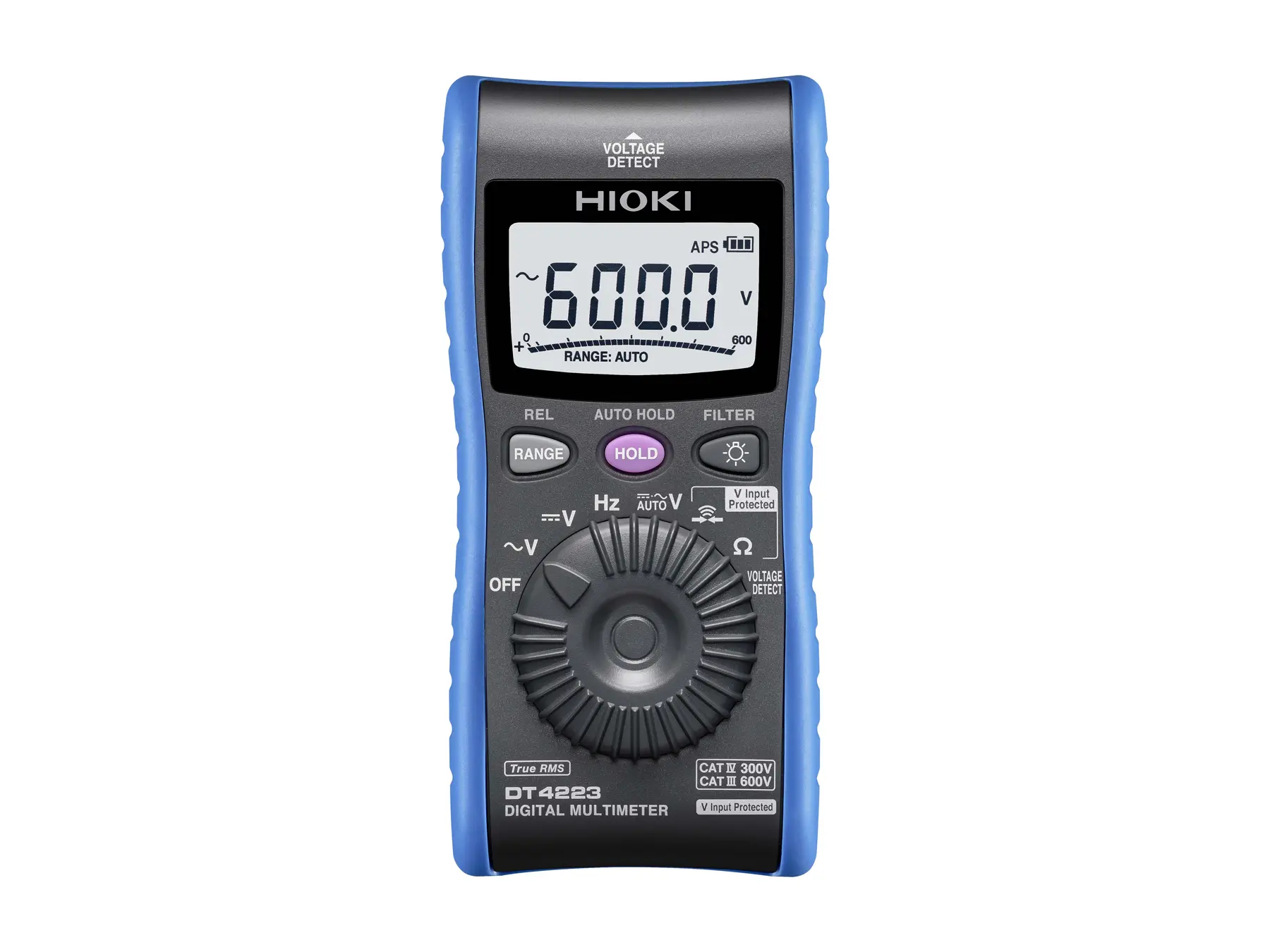
Key SpecificationsVoltage, resistance, capacitance and frequency Diode test and continuityDC and AC voltage ranges 600 mV, 6 V, 60 V, 600 V True RMS measurement CAT III 600 V, CAT IV 300 V Typical Applications  Electrical installation and service work Troubleshooting and verification of electrical circuits Versatile measurement tasks in field and workshop environments DT4223 DT4224 Common specifications True RMS AC and DC voltage measurement (ranges 600 mV, 6 V, 60 V and 600 V)Resistance, frequency and continuity measurement6000 count displayCAT III 600 V and CAT IV 300 V DT4223 specific Automatic AC/DC voltage detectionNon-contact voltage detection (NCV) DT4224 specific Capacitance measurementDiode test Detailed Product OverviewThe HIOKI DT4224 is a universal pocket digital multimeter designed for a wide range of electrical measurement tasks. In addition to AC and DC voltage checks, it supports resistance, capacitance, frequency and diode testing, making it well suited as a first tool for troubleshooting and initial analysis in both field and workshop environments. With its compact design, the DT4224 takes up very little space in a tool bag or pocket. With battery installed and test leads connected, it weighs approximately 210 g, making it easy to carry for everyday work. Powered by a single AAA battery and protected by a silicone cover, it is suitable for regular use in installation, service and workshop applications. Measurement Ranges and Safety The DT4224 is equipped with a clear 6000 count display and an intuitive operating concept that supports efficient troubleshooting and verification tasks. AC and DC voltage ranges from 600 mV to 600 V cover a wide range of measurement situations, from low level signals to mains voltage. With measurement categories up to CAT III 600 V and CAT IV 300 V, it is suitable for work on distribution boards and fixed installations. For safe troubleshooting in active circuits and complex electrical installations, the instrument is equipped with an integrated protection function that prevents false tripping of circuit breakers in case of measurement errors. If measurements are accidentally performed in the resistance or continuity mode on an active circuit, or if the measurement function is changed with test leads connected, the input impedance remains high. The input is only switched to a low impedance state once the measurement condition is recognized as safe Although extremely compact, the DT4224 is a high quality digital multimeter designed for professional installation, service and troubleshooting work. Like all HIOKI digital multimeters, the DT4224 is developed in Japan and manufactured at HIOKI’s own production facilities in Japan.

€168.00*
View product
HIOKI DT4223 digital multimeter cat iii 600v cat iv 300v installation and service HIOKI DT4223 digital multimeter cat iii 600v cat iv 300v
DT4223
HIOKI DT4223 - Pocket Digital Multimeter for Installation and Service
HIOKI DT4223 pocket digital multimeter with True RMS, compact design and essential AC/DC measurements for installation and field service. Order now from HIOKI Europe.

€138.00*
View product
DT4282 - DIGITAL MULTIMETER DT4282 - DIGITAL MULTIMETER
DT4282
DT4282 - DIGITAL MULTIMETER
The DT4282 Digital Multimeter offers a versatile and reliable solution for precision electrical measurements. Equipped with a 5-digit display and advanced features, this multimeter is ideal for professionals handling a variety of applications, from basic voltage and current measurements to more complex functions such as capacitance, frequency, and data logging. Its robust safety ratings ensure secure usage in demanding environments.Technical Details: Display: 5-digit, 60,000 counts Measurement functions: AC/DC voltage, AC/DC current, resistance, conductance, capacitance, temperature, frequency, diode test, continuity test Additional functions: dB (voltage), % (current), data memory, auto range, true RMS Safety range: CAT III 1000V, CAT IV 600V Basic accuracy: ±0.025 % (DC voltage)

€568.00*
View product
Follow us
Newsletter
  • Subscribe to our newsletter
Measuring instruments & Accessories
  • Maintenance
  • R&D / Production
  • Accessories
  • SALE (- 20%)
  • Spare parts
Measurement solutions & tips
  • • Zero-Flux Current Clamps: from mA to kA​
  • • Wideband Current Sensors up to 500A & 120 MHz
  • • The Most Versatile Multi-Channel Data Logger​
  • • Precision Current Data Logging. Ultra-compact.
  • • Measure Power with Precision – Across All Applications
Blog Articles
  • • DC Current Measurement and Bandwidth​
  • • Zero-Flux Current Sensors: Like in “Back to the Future”?
  • • Your Path to Better Energy Efficiency: Current Mapping​
  • • Never Miss a Beat: Choosing the Right Sampling Rate for Data Acquisition​
  • • A dedicated resistance meter? Here is when it makes sense…​
Customer Service
  • About Us
  • Shipping & Returns
  • Where else to buy
  • Contact
  • Downloads
Legal
  • Imprint
  • Terms & Conditions
  • Data protection
  • Battery disposal
  • Cookie settings
Payment methods
Credit Card (via Stripe)
Advance Payment
Pay online
PayPal
Klarna (via Stripe)
© 2026 HIOKI EUROPE GmbH

* All prices excl. VAT plus shipping costs